

Now booking · 30-min strategy calls

Unwind the MCA. Unlock the growth.

Delancey Street negotiates Merchant Cash Advance and SBA restructures for owners who need real relief, not another loan. $100M+ settled by Delancey Street.

Free Consultation
Delancey Street trusted by
1,000+ businesses
Google rating US Chamber Zogby

Delancey Street Has Settled Over $100m in Merchant Cash Advances

Delancey Street — Resolution, Not Another Advance

Clients Have Spoken

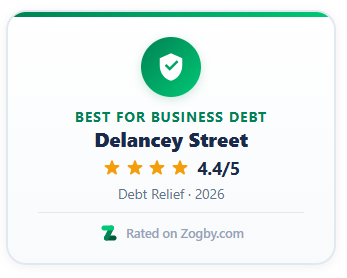
Best for Business Debt, rated 4.4/5 on Zogby.com
4.9 / 5 from 200+ reviews
Verified Google Reviews
1,000+
Businesses
helped
Tyler Wilson

“Thanks to the amazing team at Delancey Street, I am thrilled to share that I am now free of my merchant cash advances and my business is thriving. They successfully negotiated a great deal on my behalf while keeping me informed and updated every step of the way.”


Tyler Wilson
CEO, IT Services Company
Brooklyn, NY
Samantha Cooper

“Delancey Street's approach was characterized by immense patience and a deep understanding of our needs. They meticulously guided us through the entire consolidation process, offering insights into potential payment plans and alternatives.”

Samantha Cooper
CFO, Event Management Company
Long Island, NY
Craig Donnelly

“They didn't sugarcoat it which I liked. Overall, they were kind, professional and easy to work with. Most of all, they got the job done. Idk what they did, but the phone calls stopped and my cash flow was so much more manageable.”

Craig Donnelly
Founder, General Contractor
Newark, NJ
14+
Attorneys
In our network
50
States
Coverage
1,000+
Settled
MCA cases
$100
Million+
In MCAs settled
The Delancey Street Track Record

Delancey Street is a vetted merchant cash advance relief team, with industry experts you can count on!

Delancey Street is a merchant cash advance settlement partner for real businesses with real struggles. The Delancey Street team offers smart, strategic merchant cash advance resolution rooted in industry experience, precision, and unwavering transparency.

At Delancey Street, we're not here to judge. We're here to clear a path.

Delancey Street was founded and is managed by merchant cash advance specialists and industry insiders. We combine credibility with empathy to help businesses restructure, rebuild, and grow the right way.

Free Consultation
Industries Delancey Street Serves

No Matter Your Business,
Delancey Street Has Got You Covered

Real People. Real Delancey Street Success.

Restaurant Owner
New York, NY
42% Savings
Total MCA
$425,000
Weekly Payment
$2,125
Duration
6 mo.
Total Savings
$178,500

Illustrative examples of prior Delancey Street engagements. Individual results are not typical and vary by funder, balance, and circumstances. We do not guarantee any specific reduction or outcome.

Real Delancey Street settlements. Names withheld for client privacy. See all case studies
How Delancey Street Works

From "I'm drowning"
to "I'm clear."

Delancey Street is a four-stage process built by merchant cash advance specialists and former MCA insiders. Every Delancey Street case gets a written, engagement-specific plan at intake. You stay focused on running the business, and Delancey Street handles the negotiation, the paperwork, and the funder calls.

4
Stages
$100M+
MCAs resolved
Case-by-case
Strategy mapped to your situation
01
Step 1

Intake & Triage

Dedicated case team

Confidential review of contracts, ACH activity, UCCs, and any active legal threats. We map the full picture before we touch a phone.

You receive
  • 30-min senior advisor call
  • Full MCA schedule
  • Triage memo & game plan
02
Step 2

Strategic Analysis

Find your leverage

Deep dive on each contract: usury exposure, COJ vulnerabilities, breach claims. We identify where your funders are weakest.

You receive
  • Per-funder leverage report
  • Settlement target ranges
  • Risk-ranked priority list
03
Step 3

Expert Negotiations

Funders only talk to us

Senior-advisor-led negotiations across every funder, in priority order, with independent counsel looped in where legal matters arise. We handle the funder calls and the paperwork while you focus on running the business.

You receive
  • Restructure & settlement proposals
  • Negotiated payment relief
  • Signed agreements where settlements are reached
04
Closeout

Recovery & Rebuild

Cash flow restored

Final closeouts, lien releases, credit guidance, and an operating plan so the cycle doesn't repeat. We finish the job.

You receive
  • Lien & UCC release support
  • Credit & banking guidance
  • Post-resolution follow-up plan
Senior advisor at Delancey Street Live now
Step 0 · Today · Delancey Street senior advisors available
Free, confidential 30-min Delancey Street strategy call.
Real plan from a Delancey Street senior advisor in your inbox same day, with outside counsel available when needed. No obligation.
Get Started

Explore a Path Out of
Your Merchant Cash Advance

Tell Delancey Street a bit about your situation. A Delancey Street senior advisor reviews every submission and responds within 30 minutes, confidentially, with no obligation.

  • 100% confidential
  • No obligation, free consultation
  • Senior advisor reply < 30 min
01 About You
02 Your Business
03 Your MCA
Straight answers

Questions owners ask before they call us

13 questions, with the actual mechanics behind each answer. No marketing fluff. If your question isn't here, we'll answer it on the consultation call.

The Basics

Start here, the terminology

What's the difference between settlement, restructuring, modification, and a workout?

These merchant cash advance relief terms get used interchangeably and shouldn't be. Settlement is a discounted payoff resolving the advance entirely. Restructuring is renegotiating the terms (rate, term, payment amount) with the advance still owed in full. Modification is a narrower change to specific terms, often documented as a contract amendment rather than a new agreement. Reconciliation, for example, is a contractual modification that can also result in an adjustment to your payback. Workout is the broader umbrella term covering any negotiated change to a distressed obligation, including all of the above. Each term has a different legal implication and unlocks (or forecloses) different defenses.

What does it mean when my funder "sells" my merchant cash advance to a collection agency?

Two different things happen in the industry, and the distinction matters. In a true sale, the funder transfers ownership of the advance to a buyer (often for pennies on the dollar) and the buyer becomes the new creditor. Your defenses and contract terms travel with the advance.

In a placement, the funder keeps ownership but hires a third-party collection agency to recover, paying them a contingency fee on whatever they bring in. The funder still owns the advance; the collector is just an agent acting on the lender's behalf. The wording on the notice you receive tells you which one is happening, and it changes who you're negotiating with.

The Math

How funders actually price a settlement

What's the actual recovery math the funder is running when they decide to settle?

When a lender is deciding what offer to accept, they're not anchoring to your balance. They're running a recovery curve that estimates what they'll net after legal spend, present-valued against their cost of capital (12–18% for most MCA shops), and the probability of actually recovering funds. Time is a factor: how long will it take? Could they recover 60 cents today, lend it back out at a 1.5 factor rate, and earn more than they would chasing your full balance? It's a multivariable equation.

The bottom line: there is no hard-and-fast rule. Every situation is unique. If you're talking to a merchant cash advance settlement company taking a cookie-cutter approach, you're talking to the wrong company. Delancey Street prides itself on a tailored approach for every client. Before we accept you, we look at your situation, dig deep, and peel back as many layers of the onion as possible to understand exactly where you stand.

Why do most settlements happen after default, not before?

Because default is what creates the urgency that makes funders willing to negotiate. A current, performing account will not get settled at a discount, it's just counterintuitive. Why would a lender give up principal to someone who isn't actually struggling? Funders detect a comfortable ability to pay and refuse to discount.

That's the uncomfortable truth the no-fee MCA-relief lead-gen sites won't tell you. A lot of firms will only engage you from an active-default posture. They won't tell you to default (and neither will we), but they only get to work once you have. The work we do is figuring out how to make that transition controlled, not chaotic, so you don't burn negotiating leverage in the first 72 hours.

Why do funders settle at different numbers in different quarters?

Funder behavior isn't constant at all. Every funder has their own book, their own underwriting guidelines, and their own internal parameters. Settlement landing zones shift based on portfolio performance, what their lender (the capital provider behind them) is pressuring them about, regulatory developments, and macro conditions. Virtually every lender has a different idea of what success looks like for their book. Each funder is a different personality.

A funder that was taking 45¢ in Q1 might be taking 32¢ in Q3 because their write-off quota for the year hasn't been hit and their portfolio manager is closing files aggressively. Same funder, same fact pattern, different number. This is why a settlement firm that closed deals with a specific funder in 2023 isn't necessarily current in 2026, funder behavior shifts, and the playbook has to shift with it.

Strategy & Traps

Order of attack, and what to avoid

Should I settle my front-position MCA first, or the back-of-stack one?

Most people instinctively go for the cheapest deal first because it feels like a win. Wrong order. Settle the most aggressive position first, the one filing COJs, freezing accounts, calling daily. Buying peace from the loudest creditor restores operational stability, which restores cash flow, which funds the rest of the negotiations.

At the end of the day, this is a conversation we need to have with you once we understand the full picture. Order of attack is one of the most consequential decisions in a stacked-MCA workout, and it's a decision we make case by case.

My funder is offering me a "renewal" or "consolidation", should I take it?

This is the most common trap in the industry. It looks like relief, but it's really just a bigger merchant cash advance under a different name. When you're struggling on an MCA, the funder will frequently offer to “consolidate” your balance into a new, larger advance with a longer term and a fresh factor rate, sometimes called a “refi” or “renewal.”

What actually happens: the new advance pays off the old balance, you get a small amount of new working capital, but the total payback obligation balloons because the new factor rate applies to the entire new amount (old advance + new advance). It is not a permanent solution. It offers nothing except relief, and when the pain returns, it returns twice as hard. You've now committed to paying back significantly more money over a longer period, with a fresh COJ, a new UCC filing, and an extended personal guarantee.

Renewals often increase your total payback by 30–60% in exchange for short-term cash flow relief. Remember, you're signing up for a 1.5 factor rate (or something equally high). Some are legitimate. Many are designed to convert a distressed account into a healthier-looking one on the funder's books, while doubling your obligation.

The Paper

Contract mechanics that move the number

What's the "true-loan recharacterization" thing, and why does it matter so much?

MCA contracts are deliberately drafted as “purchases of future receivables” to dodge state usury caps. That label is how funders charge rates that would otherwise be illegal under state lending laws. Even the CFPB has noted that MCAs are “structured differently from traditional lending products.” But courts increasingly apply a multi-factor test: does the contract really track receivables, does reconciliation actually work, is there real risk of loss, is the personal guarantee triggered on ordinary business failure? If a court decides the contract is a loan in disguise, the entire enforcement structure can collapse, usury becomes a defense, COJ enforcement becomes vulnerable, and settlement leverage jumps dramatically.

What's a "release" actually doing in my settlement agreement, and why does the wording matter?

A release is the contractual provision that extinguishes the creditor's right to come back at you later. The wording is everything. Many of the prospective clients we talk to have informal, word-of-mouth understandings with their lenders, “okay, we'll just lower the payments”, but nothing is papered.

Settlements that pay the money but get the release wording wrong leave the door open for the funder to come back later for “additional amounts.” The release is the actual product you're buying. The check is just the price. We see deal after deal where merchants paid the discounted settlement but the agreement was silent on a specific category of recoverable amount, and the funder came back a year later to collect it. Don't settle for a release that isn't airtight.

Operations & Defense

What funders do, and how you defend against it

What does invoking reconciliation before default actually do?

It rewrites the entire strategy. Pre-default, you're a customer exercising a contractual right. MCA lenders are required to offer you reconciliation, that's exactly how they're permitted to charge effective rates that would otherwise be usurious. The contract isn't classified as a loan because, in theory, you're selling a percentage of receivables, and that percentage has to fluctuate with revenue. If your revenue drops, the daily debit has to drop with it.

Post-default, the calculus flips. Asking for reconciliation now sounds like a defaulted borrower asking for a favor. A documented reconciliation request that the funder ignored, however, becomes evidence the “purchase of receivables” was a disguised loan, which collides with their COJ enforcement, opens usury defenses, and pushes settlement numbers down. Almost nobody invokes this clause because MCA funders gaslight merchants into thinking it doesn't exist or doesn't apply. It does. Many lenders will fight back, claiming there's no downtrend in revenue even when bank statements show one.

Will the settlement actually be invisible to my customers and vendors?

For MCA settlement, probably yes. Most MCAs don't report to credit bureaus, and settlement documentation is private contract law, your vendors, customers, and bank typically don't find out. That said, some of the higher-end MCA lenders are starting to report to credit bureaus, so it's a mixed bag and the trend is moving against borrowers.

The hard line is this: unless the funder has already sent UCC § 9-406 notifications to your customers directing them to pay the funder instead of you, your customer relationships are likely still intact. Once those notifications have gone out, the cat is out of the bag, and recovering those customer relationships becomes a separate, much harder problem.

Why does my funder keep calling my customers?

UCC § 9-406. When a funder files a UCC-1 lien on your receivables and you default, § 9-406 lets them send written notification to your customers (the “account debtors”) directing those clients to pay the funder directly instead of you. They will often threaten your clients with legal action if they don't comply.

This is one of the most damaging operational moves a funder can make. It exposes your distress to your customers, it can trigger contract clauses in your customer agreements (some have “no-encumbrance” provisions that allow customers to terminate), and it often destroys those relationships permanently. Stopping § 9-406 notifications, or unwinding them once they've gone out, is one of the higher-leverage moves in a workout.

What's the single biggest mistake merchants make in the first 72 hours after they're served?

Calling the funder directly to explain hardship. That conversation gets recorded, becomes evidence of inability to pay, and accelerates the funder's enforcement posture.

The second biggest mistake: wiring a partial payment “to show good faith,” which resets the default cure timing without resolving anything, and signals you have cash they didn't know about. The third: promising payment dates the business can't actually meet, which destroys your negotiating credibility for the rest of the engagement. In every one of these scenarios, the funder gains information they didn't have before, and you give it away for free.

30-minute consultation · free · confidential
Live · We're answering today

Let's beat
bad merchant cash advances with Delancey Street.

A Delancey Street senior advisor will review your situation in under 30 minutes. Free, confidential, and 100% obligation-free.

Free consultation
No cost or obligation to talk through your situation.
No credit check
We never pull your credit on a consultation.
Direct line to a senior advisor
No call-center triage, no junior intake.
Or call us directly
104 W 40th Street, New York, NY 10018 · Mon–Fri 8a–7p ET
Free Consultation
Tell us about your merchant cash advance.
Takes
~30 sec
100% Confidential No Credit Check 4.9 / 5 (1,000+)
Call Now Get Free Help